
Rainbows Keep Showing Up
Walking with Jesus seems impossible, but it's not

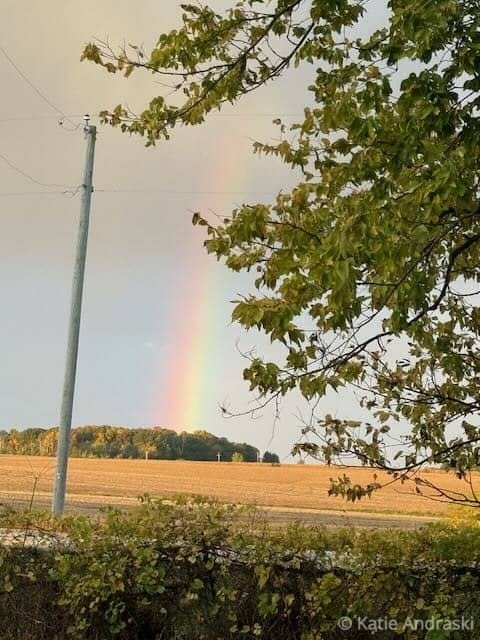
Bruce alerted me to the rainbow dropping out of the clouds off to the west. It practically sat on our across-the-field-neighbor’s woods. I snapped a picture as I walked out. Then stood by him and watched to see if there would be enough for an arch. There wasn’t quite, the clouds ending in clear sky. So much about these rainbow sightings speak to me about God’s judgement. How He can’t allow wickedness to continue on the one hand. How he promises he will never drown the earth, on the other. Though in baptism, we are drowned, we are put to death, in the name of the Father, and the Son and the Holy Ghost. The old creation in us is no more. We rise to new life in Christ. Flood waters and rainbow. Well, I said something like that last time.
Since the house blessing and bringing Aiden into our home my feelings have returned. Tears are welling up easier than they have in the last few years. It’s strange to feel something and not drop so easily into silence. But I have prayed the Lord would exchange my heart of stone for a heart of flesh. Just maybe He has.
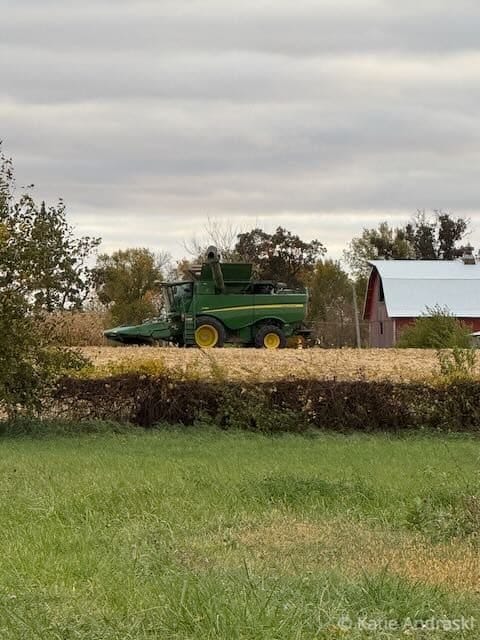
The big machines arrived in our neighborhood to finish harvesting corn. It’s surprising how the combine’s chewing corn, separating kernels from stalk and shucks can fill the morning with its presence, and the sun barely breaking the horizon.
Stephen Freeman’s essay The Ascetic Imperative took me up short, took me into the impossibility of living like Christ, making Christ known to the world. As much as I read about God’s love, how wide, and broad and high and long it is, how he will in no wise cast us out, how his mercy reaches to the heavens, sometimes I find myself afraid of the Lord and his judgement. The Psalmist expresses this in Psalm 119: 120, “My flesh trembles for fear of you, I am afraid of your judgements.”
Freeman quotes St. Paul’s first letter to the Corinthians:
You are our epistle written in our hearts, known and read by all men; clearly you are an epistle of Christ, ministered by us, written not with ink but by the Spirit of the living God, not on tablets of stone but on tablets of flesh, that is, of the heart.” (3:2-3).
He rightly challenges us to not do what our culture bids us do. Freeman is speaking the truth but sometimes the truth holds up a mirror, that’s no fun to look at. I slid into a pit thinking how impossible it is to live as an “epistle of Christ” these days. Freeman says:
To live mindlessly in this culture is inevitably an act of “channeling” the culture, of living as an expression of the culture in human form. We shop because the culture shops. We “care about stuff” because the culture “cares.” We worry because the culture worries. We weep when it weeps and become angry as it rages. We unconsciously live as “epistles” of the culture (the Scriptures would name it as “Mammon”) even as the culture whispers to us that these are our own thoughts…If you feel no tension with the culture around you, then you have been swallowed alive and are being digested.
Well, he’s right. And to be honest I’m not sure I want to stop ordering books from Amazon or buying stuff for my dogs. I’m not sure I want to stop worrying about the chaos all around. Because I celebrated my birthday this week, I took myself to Facebook to read everyone’s birthday greetings. It’s both gracious and wearying to be greeted by so many people I’ve met through my life and through Facebook. Then someone’s outrage took residence in my thinking. I’d wake up thinking what I would say. (Though later she asked me to offer my perspective privately. It was a good conversation. Those are still possible.)
My heart has hardened because I can’t bear to hear about another person’s cancer diagnosis or deceased horse or children going without food, especially with the government shut down. I’ve been waking up, my heart tight in my chest even though rainbows show up across the road; a bald eagle swings and swoops over the fields; farmers park four semis at the top of the north field to carry that field’s harvest of corn.
As far as ascetism goes, heck I can’t even give up Diet Coke/Diet Pepsi, even though I told you how I was going to abstain. I know it’s not good for my brain or my kidneys, or this temple of the Holy Spirit. Fast food is a favorite. I’ve channeled the culture by allowing a corporate giant take control of my desires.
I’m not sure we can completely separate ourselves from the culture we live in. Paul Kingsnorth in Against the Machine identifies how the country we are born into offers good things.
“At its best, a nation is both a home for a people and repository of history. At its very best, it may be built around some spiritual or cultural story that transcends Machine value, and its laws and tradition may offer people something other than participation on the metastasizing consumer globalculture” (195 - 6).
In some ways the nation and the culture that I’ve been born into act like clothes. We’re told in scripture it’s not good to be naked, even on a wider level than the shirts, pants and dresses we wear. The road I walk, the fields across the way, our home, my neighbors, my church, my township, county, state and federal governments are all layers I wear whether I want to or not. These things help me know who I am and where I belong. But increasingly Kingsnorth is noting that our phones are unmooring us from these places and our sense of place and sense of self.
He wonders,
When the phone in your pocket allows you to make more friends in other countries than you can at school, when the whole world is converging on the same digitally enabled globoculture, when you can log onto Instagram in Austria or Australia and order from Amazon in the Amazon what does your nationality even mean? Travelling round Europe and America recently, seeing this reality in several different countries, I was hit by the striking possibility: that the Machine is birthing its own ethnicity. It is a globalized, screen-enabled, placeless identity that, for many people, seems to be replacing any older national or regional cultural markers. (202)
I have felt this. I received over 200 hundred birthday wishes from people on Facebook but not very many live within a fifty-mile radius. And most would not be geographically available for moral or physical support should our 70 years catch up to me or Bruce. Even talking to a local friend on Messenger robs both of us of our physical presence and facial/body language that help convey how we are responding to what the other is saying. (Meta is taking away the messenger app on our computers and forcing us to use Facebook to direct message people.) It’s not as convenient arranging to meet in person when it’s easy to make a few clicks and start chatting.
But Kingsnorth also aligns with what Freeman says about resisting what this global culture has become and offers some practical advice about how to resist. He says,
The right kind of warrior takes on his own internal demons before he sails out to those of others. He takes his stand and stands his ground without giving into the nihil of the age, He cleaves to what he believes in without falling into the traps laid by partisanship, anger and self-righteousness. Most of all, he works to clear out his own inner junkyard, so that he can go searching for the truth—and recognize when he finds it. His war is against the worst of himself and for the best of the world, and what he is fighting for is the love he so often fails at. His most effective weapon is sacrifice. (166 – 7).
It’s not easy fighting those internal demons, and sometimes it’s not even demons, but a consistent wake time of 4 am and your eyes burn and you’re edgy with over tired tension. As the Psalmist says in 119: “I rise before dawn and cry for help; I hope in your words. My eyes are awake before the watches of the night, that I. may meditate on your promise” (147 – 148).
Freeman ends his post by saying,
There is an ascetic imperative, an utter necessity to enter into the struggle that is Christ’s own struggle. We fast because Christ in us fasts. We pray because Christ in us prays. We forgive because Christ in us forgives. We love because Christ in us loves. We give because Christ in us gives. Such a life is a sign of contradiction, a repudiation of the world’s claims to be “normal” or “just the way things are.” The life of Christ is the true life of the world, the purpose of all things.
And there is no way I can live this. I hardly know what it means to take up the cross and deny myself. I am weary of waking up, praying through my prayer list, no longer sure it helps to pray chronically for someone. Apparently, the story of the widow bugging the judge to give her justice doesn’t mean we should pester God. But, but I have experienced the power of other people’s repeated prayers in my life, so I keep saying my prayers. I no longer repeat “Lord be merciful to me” without adding “your mercy endures forever” so I can find reassurance for that mercy. I am weary of asking, who will listen to my story, rejoice with me or weep when I weep because everyone I know is suffering extreme hurt. I am aware that a person can lose the ability to make conversation if silence goes on long enough.
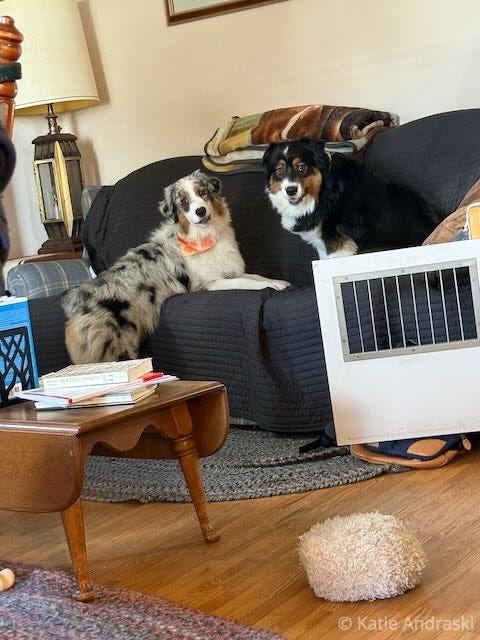
On the way home from dog class, where I sent Aiden in for a bath and saw Omalola’s eyes light up when I pointed her to an agility course (She ran up an A frame that she wasn’t supposed to go near, twice. She jumped every jump, when at home she just blasts through them), I listened to Speakeasy Theology. In “The God of Hope Does not Disappoint” (Oct 20, 2025) I heard Chris Green and David Harvey talk about one of Karl Rahner’s sermons. I listen loosely while I’m driving, glancing out at cloud shadows over a clipped countryside that’s become a patchwork of browns and tans with green waterways.
Towards the end they said the following:
There’s going to be mercy. There’s going to be forgiveness. There’s going to be consolation, which means there will be things you need mercy for, things you need forgiving for, things you need consolation for.
And yet, all of that belongs to God working your life out. He started a good work. He’s going to bring it to completion.
And where that puts you, where it puts me, is a place of peace. You can live your life with all of your failures to live it well, because God is living it with you. God is working with you in the living of it.
And be at peace with that. Be at peace with that.”
And a little further on they say:
So that when God saw you, he always saw you as someone who was inseparably bound up with Jesus. And when he saw that, he was seeing himself, he was seeing his son.
And that’s just how God is God and how God is our God. And I think Bonhoeffer sees this, sees this, too. And what that means is your life is as sure to work out as God’s life is.
Because what’s happening in your life is nothing but your own life being harmonized with God’s life. And that’s why Paul can be so sure. He began a good work, and he was going to complete it, because he is already his own completion.”
So that when God saw me, he saw me as someone bound up with Jesus. And this a response to how I perceived Stephen Freeman’s words (though in reality he was saying the same thing). As I turned toward home, I found these words comforting, offering promise that already I am Christ in the world, working out my little life. Now if I could lean into this confidence by faith.
Oh by the way, that essay, “How I Shucked what People Thought of Me or The Virgin and the Creative Writing Workshop” did not make The Masters Review cut as far as publication or a prize. This comes as a disappointment and a relief. The essay flies in the face of a cultural narrative and would have taken a bit of bravery on The Masters Review and my part to see it published. But being a finalist is an affirmation to keep working on my memoir/essay collection. I sent out an essay about baptisms to Missouri Review last week. Then I saw a sophisticated list of evangelical things progressive Christians don’t believe any longer. My heart sank because the faith I describe to these secular readers is very much full of those evangelical beliefs.

Katie, I would love to have a phone date with you! How true we need communication to confess our salvation, our daily salvation because Jesus lives within us and we are still in 'time'. He is the way into His kingdom and out of the kingdom or culture of the world. Jesus is not a plan but a person. We can encourage each other's faith as we listen to His voice and watch what happens!
"If you feel no tension with the culture around you, then you have been swallowed alive and are being digested."
And then after the digestion, we get shat upon the ground for flies to lay their eggs in or for giants to accidentally step in and fill the air with their profanities.
Sorry for the grossly crude comment. I'm not sure that your post was intended for this, but then again, I'm not sure that it wasn't. But it's what came to me after I read your description of a people losing their identity, especially when that people are the so-called "Bride of Christ."
Weep. WEEP! If the tears will still come.